

《Pachelbel's Canon》for Two Violins, Cello and Guitar (for Two Violins, Cello and Guitar)
J.Pachelbel(1653-1706) · 어쿠스틱 기타, 바이올린, 첼로
어려움
33% $4.50 $3.00
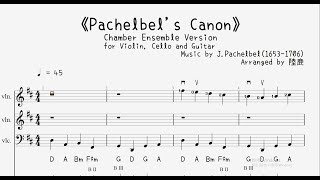


J.Pachelbel(1653-1706) · 어쿠스틱 기타, 바이올린, 첼로
《卡農》(Canon in D Major)是德國巴洛克作曲家約翰·帕赫貝爾(Johann Pachelbel, 1653–1706)的代表作之一。原作大約創作於 1680–1690 年間,為三把小提琴與通奏低音(basso continuo)所寫,常搭配一首 Gigue,合稱《Canon and Gigue in D Major》。
此曲以「卡農」(canon)形式展開,三個旋律聲部依次模仿進入;同時在大提琴與通奏低音中,持續反覆的八小節低音進行(ground bass)構成整曲的和聲基礎。由於旋律優美、結構嚴謹,後世常被改編為各種樂器組合,成為婚禮、典禮及大眾音樂中最受歡迎的古典名曲之一。
Background
The Canon in D Major is one of the most renowned works by the German Baroque composer Johann Pachelbel (1653–1706). It was composed around 1680–1690 for three violins and basso continuo, and is often paired with a Gigue under the title Canon and Gigue in D Major.
The piece is built on a canon, where three melodic voices enter successively in strict imitation. Beneath these voices lies an eight-bar ground bass, continuously repeated by the cello and basso continuo, forming the harmonic foundation of the entire work. Due to its elegant melody and structural clarity, the piece has been widely arranged for diverse ensembles and is especially popular at weddings, ceremonies, and in popular culture.